Showing posts with label ECM. Show all posts

Tuesday, November 13, 2012

I am back....

Just a quick note to say I will begin posting again here soon.  I am in the process of writing a book on the topic of "Why enterprise IT projects so often fail". Will be sharing thoughts and updates as I research and write. The chapter structure has been built, the publishing proposal drafted and a sample chapter written.  All I need to do is get a publisher, and I am working actively on that right now...

Seven years ago I started this blog as an outlet to pull thoughts together for this book - but life and other writing commitments got in the way in the intervening years. That may happen again, but fingers crossed this time round I will finally get the job done!

Thursday, March 25, 2010

ECM does not equal Green IT


There are two things that instantly get my back up these days. ROI/ Pseudo scientific IT calculations and the claims of the Green IT movement. To be clear upfront, I am the resident Tree Hugger at The Real Story Group and take the environment and our stewardship of it seriously, I also believe that information management initiatives can and do deliver clear and measurable results. But maths that only tackle one side of the equation, and Green claims based on hot air really do not resonate with me.


So imagine my apoplexy when I read an article today that claimed that you could radically reduce your carbon footprint by utilizing ECM software. Again, to be clear - my blood pressure is not rising because I don't believe its possible, rather it is because of the wacky math that is used to support such a claim. In this article (including graphs) the measure of success was the fact that this University 'saved' 347,000 paper pages in the admissions process this year. Instead of the paper documents, they used electronic documents. The carbon footprint reduction came through saving lots of trees (43 trees to be precise based on their calculation of 16 reams of paper from a single tree). This all seems like laudable stuff until one stops think about what is missing in this lopsided calculation.


First, and fairly obvious is that the University has not apparently heard of recycled paper, secondly and probably more importantly there seems to be an assumption here that electronic documents do not have a carbon footprint. No apparently, the toxic time bomb that constitutes a computer these days counts for nothing, nor does the power to run the computers, servers, data centers etc. No discussion either at the ease of proliferating multiple and redundant copies electronic documents. I have no idea what the actual carbon footprint tally for running a document management system is, but I know its not zero.


Nonsensical calculations, and spurious eco-claims are totally unnecessary in the world of information management - just a look around at the information chaos we call normality is enough to tell us there is business value in doing the job properly. You can build real business cases, and use real numbers - you can measure information management success properly and accurately, there is no need to wander into fantasy.

Tuesday, April 14, 2009

Vendor demo implosion


What a day! I shall marshall my thoughts and write something more considered for CMS Watch later in the week. But sufice it to say that I witnessed the worst vendor demo to a prospective buyer I have ever seen. It was a disaster, and yet it should not have been....

The vendor (who shall remain nameless) has the tools and the skills to set a very high bar in this particular product selection process. Yet they missed the boat by a mile. For some reason they arrived with 7 people (why?) and one or two of them clearly were not as briefed as the others. Unfortunately the weakest link in the team, was also the most important part of the demo puzzle today.

Just a tip or two to any vendors out there

Firstly, never ever under any circumstances (ever) display scripting during a demo. That is suicide, the only time the buyer should ever see it is when they ask to.

Second tip, listen to your audience - if they pep up and show interest build on it - don't drag them back to the stuff that glazed their eyes.

Third tip, people want to see real demonstrations that at least approximate their working environment and the issues they detailed in the RFP

Fourth tip, it is ok to show examples you made earlier. Yes we want a real live demo, but we understand you cannot build the empire state building in a day - its ok to show us a few examples of outstanding interfaces, processes whatever - alongside the real demo which by definition will always be limiting and limited

Not a good day - two more demo's to come, they left in a huff - we all felt bad. But with two days to go, they can't be any worse - can they?

Thursday, April 02, 2009

Back from AIIM Expo 2009


Yesterday was a long one (if fun) for me, and I am relieved to be home and back at my desk. I did 3 sessions at AIIM and they were all demanding. I did a point/counterpoint argument/debate with Dan Elam that the crowd loved (as did I). I then did Stump the Consultant in the afternoon - another full house - drawn I suspect to see the 'experts' humiliated on stage - a session made somewhat complex when two of the randomly selected questions from the audience happened to be from CMS Watch customers! I Finished the day off with a co-presentation on SharePoint with Tony.

What of the Expo? Foot traffic was clearly down on last year, the On Demand portion of the show continues to dominate, our new booth looked awesome. But......not at all bad, was my conclusion. A bit quieter than we would have liked at times, but we met with a lot of our customers, and met (hopefully) many new ones. Lots of good sessions (though maybe a few too many scheduled side by side) providing a solid education track.

Attendance at the pre-conference tutorials and Tony's SharePoint workshop today have been surprisingly high, and the 3 sessions I mentioned above (along with the Analyst panel we hosted the previous day) were all in large rooms, and were full or nearly full. Considering the state of the economy and the associated difficult in getting budget to attend such events, it was a success.

I will be thinking more about the information, gossip and observations I got at the show - and writing more about the for CMS Watch once things have filtered through, but I was struck with two things in particular at the show.

1: Microsoft, Oracle and SpringCM (big suprise) acting as virtual hubs on the show floor
2: The notable reduction in Java offerings for ECM outside of the very high end - something that was glaringly obvious but unoticed by me till Kas pointed it out

Much to ponder - a good week overall - much better than I expected.

Thursday, March 26, 2009

Recession? What recession?


I can't believe its been over a year since my last post......

Anyway I am getting fed up with the doom and gloom regarding the 'recession' as I think as some commentators suggest "this is different to past recessions". It is, and without a doubt many people are being hurt by it and much fall out is yet to come. But its starting to feel like people understand now that there will be no quick fix, and its time to get on with life.

In my industry (ECM) there are more than a few shoots of optimism out there. Job postings are still strong, many vendors are telling me that the market remains not only steady, but in many instances growing.


On a side note, the ECM Maturity model that we (CMS Watch) along with Apoorv at Wipro, Erik Hartman and Dave Smigiel jointly developed was released into open commons a month ago. To my (if not our) amazement it really seems to have taken off with a lot of downloads, and so far some very complimentary feedback. Check it out here: http://ecm3.org/

Wednesday, August 22, 2007

Measuring the success of ECM


When it comes to measurements, industry is full of them - but IT is not. Or rather it is at a very technical level, but not at the business level.

For ECM implementations in particular, the nearest we usually get to measurements are in dodgy ROI calculations that are appended to even more dubious business cases. There should be much more granular measurements undertaken to justify and to hone ECM technology into the machine for change that it can and should be.

What I mean by this is that to run an ECM system effectively we should be constantly monitoring:
  • The processes that the ECM system drives
  • Systems usage
  • Time taken to search and access
  • Time taken from check out to check in again
  • Who is using the system and when (and in some cases why)
  • Which files are used, and which sit dormant
It's all data that is available within the system, yet few (very few) make use of it - it would be good if ECM vendors could learn from business application vendors - and provide simple dashboards and metrics templates.

Why? Why bother with all this? Because then we have control of the ECM system, and we can measure expected and required usage, against actual. Allowing us to modify and continually improve the system over time. Rather than allowing it to become an expensive online storage system - with mountains of redudancy, duplication and waste that so many become.

Saturday, August 18, 2007

Centralized or Distributed?


I was trawling through some old presentations the other day - when I came across a couple that were given at crisis points in major ECM implementations. What struck me about these was the focus on the architecture of the ECM system. In particular whether it should be centralized or distributed (most of my clients have been very large and often global in nature). The pro's and con's of federated ECM - the issues of replication etc are well understood. But what I think is less understood is the impact that this architectural approach has on ECM as a practice.

By default centralizing or conversely distributing the content management impacts the way that the content is managed - for example if we centralize then we see the following common attributes:

  • Centrally controlled and organized
  • Complex and far reaching processes across the organization
  • Sequential activities
  • Explicit and definitive content/records
  • System managed by an expert
  • Performance may be slow
  • Reliance on corporate (HQ) expertise
Whereas when we distribute the content in a federated architecture we see:

  • Control at local level
  • Simple processes optimized for local needs
  • Parallel activities
  • Distributed and fragmented content/records
  • Various levels of expertise
  • Fast performance at local instances
  • Local understanding of local needs
The decision to distribute or centralize ECM though (in my experience) is almost always decided based on two criteria - technical considerations and distrust/trust.

The technical considerations are obvious really - sometimes federating just doesn't work or becomes too costly to support - likewise centralizing can impact performance etc - but the trust/distrust thing is usually dependent simply on the culture of the firm.

In the new BPM course we stress the need to undertake full As Is and model thoroughly the To Be situations. Looking back on many of my past consulting engagements it has been all too obvious that insufficient study of needs and potential solutions was undertaken, and in nearly every case way too little understanding of the current situation was grasped.

My point (if I have one) is that when making major architectural decisions - we should always be cognizant of the business and cultural aspects that these decisions will impact..........

Friday, August 17, 2007

I'm back....


It's been a while.....not sure why really - but wasn't really sure of the relevance of the blog anymore - and I have been blogging a lot at the CMS Watch site - but there is so much going on in the industry in general I thought it was time for a return :-)

I have said it so many times its become a mantra - but ECM without BPM is a lame duck. Of course the counter is not I have said it so many times its becoming a mantra - that ECM demands BPM - without it ECMnecessarily the case - BPM can happily exist without ECM - but viewing the process as central to the project is the issue. Sadly few consider the process to be the central concern in an ECM project - result, lots of nice technology running on servers - nobody using it.

So - BPM (always my pet topic) - the training course is nearing completion and is now officially launched. A couple of weeks back I ran a train the trainer session in Washington and it gave me a chance to see the course in it's entirety (seeing the wood from the trees and all that) - I think I can honestly say we have done a great job. The course for those interested is designed for the consultants (internal or external) that will work on business change projects (for example any ECM project) - its highly practical and covers a lot of ground - students are going to have a tough but worthwhile time! The online version is pretty smooth, but if you want the message from the horses mouth then you need to sign up for one of the classroom sessions.

Secondly I am off to Kuala Lumpur to speak and run a workshop at the ECM Event there in a week or so's time. I'm really looking forward to this for a number of reasons:-

1: I always love to find out what ECM means in a new country - how it is interpreted and used there - teaching is as much a learning experience for me in these situations as it is for the attendees. I will be blogging about that at a later point.

2: Running workshops is a great opportunity for me to interact with users and buyers of technology.

3: I have never been to Malaysia before - but love the far east region

If you are in the region take a look at the conference and as always say hello (to repeat I am not as unapproachable as I look.....)

Work is starting soon on V2 of the ECM Suites Report - feedback from V1 most welcome - we got some wonderful testimonials from readers of V1 but there is always room for improvement - what worked for you and what didn't??

Longer - more focused blog entries in the coming week or so - but for now ciao :-)

Saturday, November 11, 2006

Slaves to technology


Those who know me well know that I take my music (particularly Electronica/Dance) very seriously. My iPod is playing a bunch of recent downloads and top amongst them are some albums by Nitin Sawhney. One of the tracks (on his Prophesy Album) that I have listened to many times is 'Street Guru'. It’s a track that samples heavily from a conversation with a US city Cab Driver, the driver muses on the fact that people have become slaves to time and technology…

Development has pushed us away from other people

A lot of times people are mad because they want immediate access, immediate information, but sometimes you just gotta wait and let things happen

People get in the cab & I say it will take 5 minutes and they say “it should only take 3”….nobody is going to put on your tombstone, I got here in 5 minutes instead of 7..

Technology has made us slaves to time

These are thoughts that clearly resonate with me, possibly from a different context and perspective but resonating nonetheless. The world of document/content management and workflow (you knew there was a connection coming up!) was constructed solely for the purpose of automating manual tasks and delivering and moving information at ever faster speeds. All with the intension of increasing efficiency, but efficiency isn’t simply about doing things faster…

ECM technologies are (I believe) essential in any enterprise to save them from drowning in a sea of irrelevant information. The mass of information facing people in their working life is real, and has reached a critical status – yet as I often pointed out, most of the information (documents) are irrelevant and wasteful.

Indeed it sometimes seems as if we spend our lives responding to irrelevancies, we keep busy, but don’t achieve all that much.

At the time of originally writing this post (long hand in my B&W A4 hardback notebook) I am sitting next to a man on an aeroplane who keeps sneakily responding to emails on his Blackberry mid flight to Seattle. I myself at Chicago airport earlier this morning opened my email account to see 10 emails relating to the same topic, a simple phone call to one person would have done the trick, but instead I have 10 emails with 5 people copied on each. And here is the rub, everyone wants immediate action, yet they don’t tend to see the major contradiction between these 50 emails (which would go onto to spurn yet others) that had brought closure to nothing.

Everyone wants immediate responses, to issues that may in their totality be important but are not particularly urgent. In our haste to respond, we fire off ill thought out responses that trigger yet more interactions…..”technology has made us slaves to time

Saturday, November 04, 2006

Oracle acquires Stellent - On balance a good move


Oracle finally acquires an ECM company, after initially passing on Documentum & FileNet (now owned by EMC and IBM respectively). It’s a move that appears to make sense for a number of reasons not least because:

• Oracle is very keen to make headway in the ECM market and their own attempts to date have fallen short.

• Stellent is a well respected players and gives Oracle instant kudos, expertise and visibility in the ECM sector

• At a technical level Stellent is probably the easiest (in relative terms) of the remaining ECM systems in the market to integrate into the Oracle stack

But even if at this high level Stellent appears to be a good fit for Oracle, there is no guarantee that this will be plain sailing.

• For starters even though Stellent may be a key ECM player, they are not very well represented in large enterprises

• They are considerably smaller by any measure than Filenet (IBM), Documentum (EMC) or OpenText

• The corporate culture at Stellent embodies Minnesota nice, mid Western congeniality – Oracle can be brutal

• Stellent is big enough to make integration into Oracle a challenge, but not big enough to be seen by many key execs within Oracle as strategic

On balance Stellent seems like a good move for Oracle but it is not without its challenges. I suspect the Oracle Content DB will largely remain (selling multi thousand seat low price deployments) but the Stellent product set once integrated and rationalized will provide the heavier duty components to qualify Oracle in many competitive situations, and plug specialist gaps.

Though it will not close the gap between Oracle and EMC, IBM and OpenText it does steal a march on arch rivals SAP who’s attempts at ECM related activities have been tepid at best.

For buyers and users of Stellent technologies there should be little to worry about in the short to mid term, but new buyers will need to push Oracle sales staff for clear information on forward direction.

At this rate 2007 is gearing up to be the year of ECM – for with these acquisitions digested there will be a lot of new money for marketing and R&D being pumped in by the majors. Clearly there is now growing pressure for SAP to respond, and though most of the money is on them acquiring OpenText (read iXOS), the plethora of acquired technologies that make up OpenText may present a pandora’s box that historically conservative SAP may not be willing to open.

For maturity in ECM we are almost at 1.0 with the major players owning the vast majority of the market – what they will do, and they will do many things, is still open to debate but ECM 2.0 will emerge.

For a couple of other really good persepctives on this check out:

Ralph Gammon
Tony Byrne

Thursday, October 26, 2006

No news is good news....


Apologies for the dearth of postings recently, but I have a lot going on at present - good stuff in the main (though I did strain my back travelling to Europe week or two back)...

Was contemplating writing something about the acquistion of Ovum by Datamonitor, but despite the fact that I will make a little money out of it, its just too sad to talk about.

Currently working on my keynote for the CMF2006 in Aarhus and a presentation on ECM/KM in the Oil & Gas sector - and amazingly finding the former harder than the latter! Defining and explaining the Content Management market is hard, and getting harder by the day I think....

I am rapidly coming to the conclusion that WCM & ECM are convenient myths created by vendors and analysts that have little relevance in the real world....these buckets made much more sense to me when I was an analyst, than they do now as a consultant/strategist....worrying isn't it?

Will post again soon - hopefully with the Keynote done and ready to share.....

Friday, October 13, 2006

A Strategy for ECM ?


I was very kindly invited by ECM guru Erik Hartman to give the closing speech at his ECM Plaza conference at the World Trade Center in Rotterdam this past week. My brief from Erik was to close the day out with something of a summary, highlighting some key points and to leave people with something provocative to think about. In short other than a bunch of stock slides on my laptop I had prepared nothing in advance. My plan (I have done this quite successfuly before) was to sit in on the key sessions, write my notes up - pull some obligitory slides together and go for it.

Anybody spot the error above? The conference was in Rotterdam, which is in the The Netherlands and the sessions were of course......mainly in Dutch...My grasp of the Dutch language goes no further than the names of various cheeses (Gouda etc), and an uncanny ability to mimic the sound of the dutch speaking when I have drunk too much wine. Neither of these came in particularly handy.
So what I actually delivered was more based on individual conversations throughout the day, and a couple of english language sessions....maybe next time I should have a plan B?

For me the highlight of the event (though there were other good sessions including Theresa stepping in for Tony at CMSWatch on the topic of RM & ECM) was meeting James Robertson the writer and listening to his lunchtime keynote session. James is a really nice guy who really knows his stuff - yet I disagreed with almost everything he said!
Disagreed is maybe the wrong word, maybe I just have a completely different perspective on things - for everything he said made perfect sense, it's just that if talking about the same topics I would be on a totally different track from James. This intrigues me, and I will certainly be making the effort to read more of James work. For there is a world of difference between somebody that I think is simply wrong - (vendors at conferences sometimes have that effect on me - I know they are wrong, they know they are wrong - but if they tell the truth unadulterated then they won't sell their product).
Take the issue of the need for Strategy in an ECM deployment (James by the way spend much of his time ridiculing strategy). Yet strategy was top of my mind for my team and I had worked on a webinar for AIIM that was broadcast live this past week on the topic of a Total Document Strategy - how to prioritize and structure what can be a bewildering array of demands and requirements within an enterprise for ECM related services. And it is at the word Enterprise that I think the differences first emerge between James and my persepctives...
For nearly 20 years now I have been working in one form or another in document, record and web management - as consultant or analyst etc. In that time virtually all my work has been with Enterprises - and lets remember here that enterprises are large companies (that is what the word means) I cannot remember the last firm I advised who employed less than 10,000 employees for example. In the world of Enterprises, the failure rate of ECM is shockingly high. For all the wonderful case studies on the websites of the leading ECM players, a closer look at those firms almost always reveals a different picture. Good intentions, a large budget, purchase of lots of licenses, then after a few small deployments things tail off into failure and disinterest. Frankly there are very very few exceptions - and there are many hundreds of thousands of licenses for ECM systems out there that still sit in their shrink wrap years after being bought. The reasons why these grand ECM plans invariably fail is I believe due to a lack of strategic planning, and in parrallel a lack of skills available to do the work.

It is so easy to find a department that could benefit from document, email, digital asset, records, web or whatever management system - and to get that running and show an apparant success is also easy. To sustain that success though is very difficult, and to roll that short term success out across the enterprise almost never happens.

So I am coming to the conclusion that we really need to take a different approach to ECM that is based on a solid and holistic strategy. That strategy needs to recognise that very little content is as specfic to one group or organization than we like to think, that information flows, has lifecycles - and probably the most important thing to consider at the start is, not all content is equal.
In fact I am convinced that well over 80% of the content that you are currently paying major overhead costs to sit on your fileservers, repositories and local drives is redundant. If purged and destroyed tommorow would do nothing other than free up valuable resources and allow to you to identifiy and focus on the content that is of value.

In short identifying your overall goal, prioritizing your processes and needs, and purging your system of junk (and ensuring its remains free of junk through effective lifecycle management of content) is the place to start. The place not to start is with the technology - there is no more of a dread situation than when a client asks us to help them with a new project and mention they already have a shortlist, or worse still a product selected...

This holistic ECM strategy though needs to extend also to the technical layers - repository layers (all content sitting in repositories should be interoperable) - a business process layer - a web services layer etc. This gives us a foundation to plug and play best of breed or even home grown specific tools in where required. It also gives us a layer of uniformity that is critical in managing information - for the reality is that simply purging redundancy out, managing vital information only in a consistent and secure fashion is all the ECM most companies need. 9/10ths of the functionality that firms buy in an ECM 'solution' is never used. That said, in every large organization there will be a small group or two that may have a need for some of those specialist features, but for most users, most of the time - no.

Start strategically, act tactically - prioritize your tasks - think about ECM as a prime element in any SOA or Enteprise Architecture situation - as a layer (or set of layers) that all content most utilize and conform to.

As a blog entry this is becoming too long - and as usual too rambling for comfort :-)

(For more details on what I am talking about and how we at Wipro approach this situation I would counsel anyone interested to listen to the Webinar on TDS that is still available free from the AIIM website and very ably presented by my colleague David Smigiel a fellow ECM veteran, and one with a satisfying MidWest drawl, so much more airwave friendly than my nasally English pitch).

So I shall leave it at that for now, but will when I have thought it through some more also pick up on some thoughts I was left with after chatting with John Newton at the event (founder of Alfresco) and listening to his presentation - particularly his views on Web 2.0.

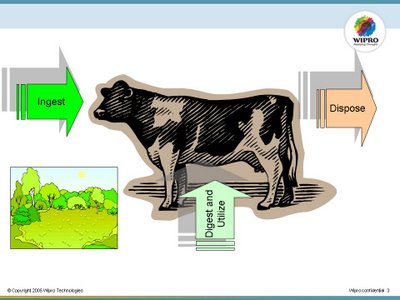
For those interested, the closing keynote was fine, I think I did most of what Erik was hoping for, though not everyone thought my slide featuring the dutch ECM cow was particularly funny........oooops. Shame as I really liked it and will likely use it again....

Next event I am speaking at will be in Aarhus in Denmark next month at the cmf2006 - a much more Web centric event so with different priorities and areas of focus....anyone who is planning to be there and reads this blog, please do come up and say hello, I am far less intimidating than I look :-) By the way anyone know if the Danes have cows? I have this slide I might use..