I was very kindly invited by ECM guru Erik Hartman to give the closing speech at his
ECM Plaza conference at the World Trade Center in Rotterdam this past week. My brief from Erik was to close the day out with something of a summary, highlighting some key points and to leave people with something provocative to think about. In short other than a bunch of stock slides on my laptop I had prepared nothing in advance. My plan (I have done this quite successfuly before) was to sit in on the key sessions, write my notes up - pull some obligitory slides together and go for it.
Anybody spot the error above? The conference was in Rotterdam, which is in the The Netherlands and the sessions were of course......mainly in Dutch...My grasp of the Dutch language goes no further than the names of various cheeses (Gouda etc), and an uncanny ability to mimic the sound of the dutch speaking when I have drunk too much wine. Neither of these came in particularly handy.
So what I actually delivered was more based on individual conversations throughout the day, and a couple of english language sessions....maybe next time I should have a plan B?
For me the highlight of the event (
though there were other good sessions including Theresa stepping in for Tony at CMSWatch on the topic of RM & ECM) was meeting
James Robertson the writer and listening to his lunchtime keynote session. James is a really nice guy who really knows his stuff - yet I disagreed with almost everything he said!
Disagreed is maybe the wrong word, maybe I just have a completely different perspective on things - for everything he said made perfect sense, it's just that if talking about the same topics I would be on a totally different track from James. This intrigues me, and I will certainly be making the effort to read more of James work. For there is a world of difference between somebody that I think is simply wrong - (vendors at conferences sometimes have that effect on me - I know they are wrong, they know they are wrong - but if they tell the truth unadulterated then they won't sell their product).
Take the issue of the need for Strategy in an ECM deployment (James by the way spend much of his time ridiculing strategy). Yet strategy was top of my mind for my team and I had worked on a webinar for AIIM that was broadcast live this past week on the topic of a Total Document Strategy - how to prioritize and structure what can be a bewildering array of demands and requirements within an enterprise for ECM related services. And it is at the word Enterprise that I think the differences first emerge between James and my persepctives...
For nearly 20 years now I have been working in one form or another in document, record and web management - as consultant or analyst etc. In that time virtually all my work has been with Enterprises - and lets remember here that enterprises are large companies (that is what the word means) I cannot remember the last firm I advised who employed less than 10,000 employees for example. In the world of Enterprises, the failure rate of ECM is shockingly high. For all the wonderful case studies on the websites of the leading ECM players, a closer look at those firms almost always reveals a different picture. Good intentions, a large budget, purchase of lots of licenses, then after a few small deployments things tail off into failure and disinterest. Frankly there are very very few exceptions - and there are many hundreds of thousands of licenses for ECM systems out there that still sit in their shrink wrap years after being bought. The reasons why these grand ECM plans invariably fail is I believe due to a lack of strategic planning, and in parrallel a lack of skills available to do the work.
It is so easy to find a department that could benefit from document, email, digital asset, records, web or whatever management system - and to get that running and show an apparant success is also easy. To sustain that success though is very difficult, and to roll that short term success out across the enterprise almost never happens.
So I am coming to the conclusion that we really need to take a different approach to ECM that is based on a solid and holistic strategy. That strategy needs to recognise that very little content is as specfic to one group or organization than we like to think, that information flows, has lifecycles - and probably the most important thing to consider at the start is, not all content is equal.
In fact I am convinced that well over 80% of the content that you are currently paying major overhead costs to sit on your fileservers, repositories and local drives is redundant. If purged and destroyed tommorow would do nothing other than free up valuable resources and allow to you to identifiy and focus on the content that is of value.
In short identifying your overall goal, prioritizing your processes and needs, and purging your system of junk (and ensuring its remains free of junk through effective lifecycle management of content) is the place to start. The place not to start is with the technology - there is no more of a dread situation than when a client asks us to help them with a new project and mention they already have a shortlist, or worse still a product selected...
This holistic ECM strategy though needs to extend also to the technical layers - repository layers (all content sitting in repositories should be interoperable) - a business process layer - a web services layer etc. This gives us a foundation to plug and play best of breed or even home grown specific tools in where required. It also gives us a layer of uniformity that is critical in managing information - for the reality is that simply purging redundancy out, managing vital information only in a consistent and secure fashion is all the ECM most companies need. 9/10ths of the functionality that firms buy in an ECM 'solution' is never used. That said, in every large organization there will be a small group or two that may have a need for some of those specialist features, but for most users, most of the time - no.
Start strategically, act tactically - prioritize your tasks - think about ECM as a prime element in any SOA or Enteprise Architecture situation - as a layer (or set of layers) that all content most utilize and conform to.
As a blog entry this is becoming too long - and as usual too rambling for comfort :-)(For more details on what I am talking about and how we at Wipro approach this situation I would counsel anyone interested to listen to the
Webinar on TDS that is still available free from the AIIM website and very ably presented by my colleague David Smigiel a fellow ECM veteran, and one with a satisfying MidWest drawl, so much more airwave friendly than my nasally English pitch).
So I shall leave it at that for now, but will when I have thought it through some more also pick up on some thoughts I was left with after chatting with John Newton at the event (founder of
Alfresco) and listening to his presentation - particularly his views on Web 2.0.
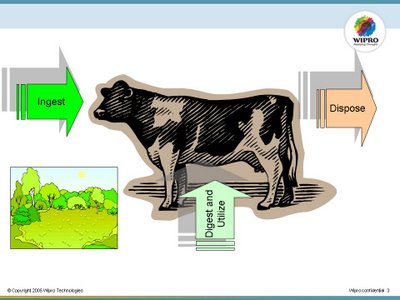
For those interested, the closing keynote was fine, I think I did most of what Erik was hoping for, though not everyone thought my slide featuring the dutch ECM cow was particularly funny........oooops. Shame as I really liked it and will likely use it again....
Next event I am speaking at will be in Aarhus in Denmark next month at the
cmf2006 - a much more Web centric event so with different priorities and areas of focus....anyone who is planning to be there and reads this blog, please do come up and say hello, I am far less intimidating than I look :-) By the way anyone know if the Danes have cows? I have this slide I might use..


